
Fields Inside Finney County Property Tax Records
Finney County property tax research blends Appraiser valuations with Treasurer billing and payment history. The county tax page is the official starting point for both halves of the record.
| Field | What it shows | Where to verify |
|---|---|---|
| Market/appraised value | County estimate for the valuation year | Appraiser record and notice |
| Assessed value | Value after the Kansas classification ratio | Assessment record |
| Taxing unit | Jurisdictions contributing levies | GIS/Appraiser and tax statement |
| Statement/taxpayer number | Keys for current and prior history | Treasurer lookup |
| Payment status | Posted installments or delinquency | Live Treasurer history |
Use the official property-tax page for current instructions.
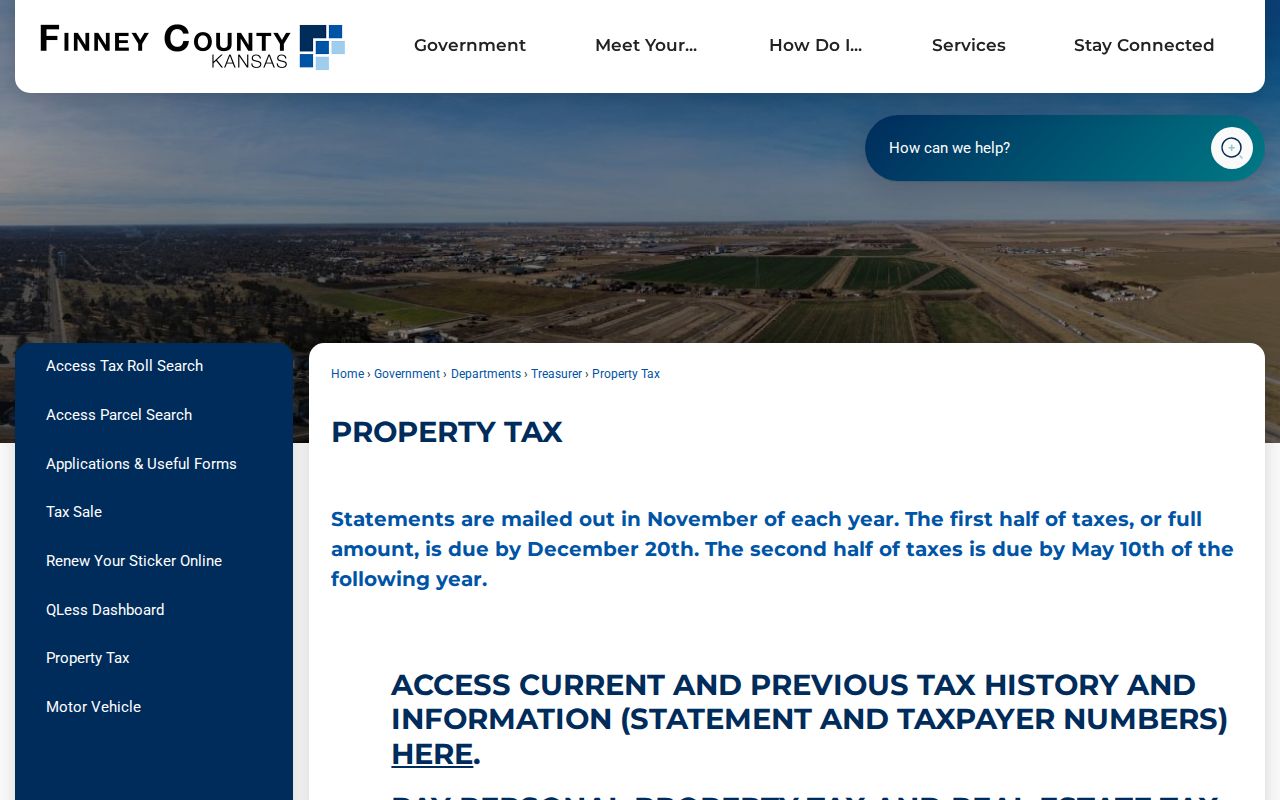
The county page routes; the live account informs.
Look Up Finney County Property Tax Records
- Identify the parcel in GIS or the Appraiser portal and save the Quick Reference ID.
- Find the statement number and taxpayer number on the tax statement.
- Use the Finney tax-history lookup for current or prior history.
- Confirm the tax year, installment, payment date, and amount in the live account.
- Contact the Treasurer before drawing a conclusion from an old printout.
A statement number and a taxpayer number are not the same as a Parcel ID, PID, Quick Reference ID, or a deed instrument number. Save every key to avoid cross-system mistakes.
Tax-record terms
Appraised or market value is the county's estimate of worth. Assessed value applies a statutory classification ratio. A mill means one dollar of tax per $1,000 of assessed value, while a tax lien is a recorded claim, not the yearly bill.
Due Dates in Finney County Property Tax Records
The Treasurer mails statements in November. Pay the full amount or first half by December 20. The second half comes due May 10 of the following year. Payment options include online payment, mail, and in-person service. A drop box sits at 311 N Ninth Street. Don't mail cash or drop it in the box. Card payments carry a 2.5% service fee under the published county instructions. E-checks cost $1.50. Confirm those costs in the current payment interface before submitting.
Value Terms in Finney County Property Tax Records
Kansas classification rules convert appraised value into assessed value before levies apply. The core formula is simple. Multiply assessed value by the total mill levy and divide by 1,000. Different property classes use different statutory ratios. Agricultural land draws its value from economic use rather than an open-market premise. GIS fields like FinalLand, FinalBuilding, and FinalTotal are clues. That is not a sale price. Rely on the notice for the valuation year. Rely on the Treasurer account for the actual bill.
2026 Context for Finney County Property Tax Records
The February 6, 2026 market study covered general residential changes of about 1% to 8%. Central-area patterns sat near 2% to 4%. Vacant values looked stable. Commercial and industrial was mixed. That summary ran within a general 5% to 10% range. One parcel can still differ. Improvements, corrected data, or a property's own comparable sales can push its result away from the trend. State 2025 change maps separately reported Finney residential change at 5.13% and total-value change at 5.05%. Neither county figure predicts a single property.
Appealing Finney County Property Tax Records
Valuation notices were due out by March 1, 2026. The county set a 30-day window from mailing. The Kansas Department of Revenue appeal guidance distinguishes an equalization appeal from payment under protest, two different routes for two different disagreements. Follow the route and deadline printed on the actual notice.
Deadline controls. A portal search does not extend an appeal window. Contact the Appraiser promptly, preserve the mailing date, and use the current county or KDOR form.
Good evidence includes the parcel record, photographs, corrected characteristics, comparable properties, and a plain account of the disputed facts. Keep it concise.
Homestead Fields in Finney County Property Tax Records
The county homestead page routes eligible residents to the Kansas refund program. It is not a parcel-popup reduction. Agricultural land's economic-use valuation can diverge sharply from a recent sale or a neighboring residential value. So confirm classification before comparing numbers. The Appraiser inspects real property on a six-year cycle and performs annual work as required. A cycle does not mean uniform percentage changes.
Delinquency in Finney County Property Tax Records
Three years of delinquency start the county tax-sale process. The case then moves through letters, certified notice, litigation, redemption opportunities, advertising, and finally auction. County-acquired property may later follow a six-month sealed-bid path. Those stages are separate. A delinquent account does not prove a parcel has sold or that redemption has ended. Ask the Treasurer for current status. Check the district-court case and look for any later recorder deed. Remember that mortgage foreclosure follows a different court and deed trail.
A Reproducible Finney County Property Tax Record
| Identity | Parcel ID, Quick Reference ID, situs, legal description |
|---|---|
| Valuation | Tax year, land/building/total, class, assessed value |
| Billing | Statement number, taxpayer number, due dates |
| Payment | Installment, posted date, amount, method |
| Challenge | Notice date, deadline, appeal or protest route |
Note the portal URL and lookup date too. Property tax records change as payments post and corrections arrive, so confirm details against the current custodian record.
Kansas Ratios in Finney County Property Tax Records
Classification drives the math. The path from appraised value to assessed value in Kansas depends on how a property is classified. Residential, commercial and industrial, vacant-lot, utility, and other categories do not share one percentage. Agricultural land is different. Its economic-use valuation can mislead when stacked against an open-market sale or a nearby residential parcel. Confirm classification first.
The general formula is assessed value multiplied by the combined mill levy and divided by 1,000. That shows structure only. The actual statement controls the levies and bill, and special assessments or corrections may call for separate explanation from the Treasurer or Appraiser.
Value and payment disputes differ. The Appraiser handles valuation and classification, while the Treasurer handles billing and posted payments, so routing each question correctly protects an appeal deadline.
Payment Channels and Evidence of Payment
Finney County collects property tax payments four ways. Pay online, by mail, at a drop box, or in person. The mail and drop-box instructions prohibit cash. Cards carry a 2.5% service charge. An e-check costs $1.50. So confirm the current amounts in the payment interface before submitting. Save the confirmation number. Then check that the payment posted to the right statement. Confirm the installment too.
If you pay by mail, keep the date, amount, and check number together. Also keep the tax year and parcel or statement details together. A bank withdrawal proves money moved. But it cannot show how the Treasurer applied it. The live tax account or an official receipt is the stronger evidence. It shows posted status on the Finney County tax roll.
Searching prior history takes the statement and taxpayer numbers used in the county-linked Kansas.gov/CIC system. Those keys are different from a GIS Parcel ID. They also differ from an Appraiser Quick Reference ID. And they differ from a recorder book and page. They are not interchangeable.
Protesting Finney County Property Tax Records
Kansas offers two main challenge routes under KDOR. One is an equalization appeal after the valuation notice. The other is payment under protest tied to the tax payment. One is not a second bite at the same valuation. Procedural limits apply. Read the current state guidance and the parcel's own notice before picking a path.
The county's 2026 notice set a 30-day window from the mailing date. Start assembling evidence early. That means the property record, corrected characteristics, dated photographs, and comparable parcels. It also means a focused explanation of why the county data or conclusion is disputed. General market headlines give context, but they are not parcel-specific proof.
The six-year physical-inspection cycle and annual appraisal work can produce corrected characteristics or value changes. Neither fact predicts an appeal outcome. Keep copies of everything: the notice, the filing, the evidence, hearing communications, and the decision.
Tax-Sale Stages in Finney County Property Tax Records
Three years of delinquency starts Finney County's tax-sale process. It does not finish it. The documented sequence runs through letters and certified notices. Then comes a lawsuit, redemption opportunities, and advertising. Bidding, possible overage, and county acquisition may follow. County-acquired property may later go through a six-month sealed-bid process. Confirm the current stage before drawing conclusions.
Check the Treasurer account for delinquency. Check the district-court file for the proceeding. The Register of Deeds shows any later conveyance. An old list alone cannot establish that a parcel was sold, redeemed, or past redemption. A current owner field in GIS cannot establish the procedural stage either.
Mortgage foreclosure is a separate matter. It moves through its own court filings and may end with a sheriff's deed or another recorded instrument. Keep tax-sale and mortgage-foreclosure labels distinct in any research chronology of Finney County property records.
Value Evidence from the Appraiser and State
The Finney County Appraiser maintains property characteristics and valuation records. Its real-property inspection work runs on a six-year cycle. The public portal and GIS supply discovery data. A valuation notice and the Appraiser file give the year-specific evidence a review actually needs. If a field looks wrong, contact the office with the Quick Reference ID.
The Kansas Property Valuation Division publishes ratio studies, change maps, market analyses, and classification guidance. It also publishes appeal information and open data. Statewide county-level measures make useful comparisons. They cannot replace the subject parcel's own record. Finney's 2025 state-map changes and 2026 county market-study ranges cover different periods. Never blend them into one parcel growth rate.
A recorded deed can help investigate a transfer. But the GIS popup displays no reliable public last-sale-price field. Keep sale consideration, appraised value, assessed value, and tax due in separate columns. Do this when reviewing Finney County property records.