
What Finney County Deed Records Contain
Deeds are only part of the collection at the Finney County Register of Deeds. The office records mortgages, assignments, releases, easements, and rights of way alongside oil-and-gas instruments, affidavits, plats, and boundary surveys. Restrictions, ordinances, resolutions, and many kinds of liens round out the land records under its care.
| Instrument | What it does | Common research use |
|---|---|---|
| Warranty deed | Conveys an interest with covenants | Identify a transfer and grantee |
| Quitclaim deed | Conveys whatever interest exists | Resolve family, estate, or corrective changes |
| Mortgage / release | Creates or releases a recorded security interest | Track financing status |
| Easement / right of way | Records use rights affecting land | Research access and utilities |
| Plat / survey | Depicts subdivision or boundary information | Connect lot-and-block text to place |
Review the Register of Deeds page before choosing an access channel.
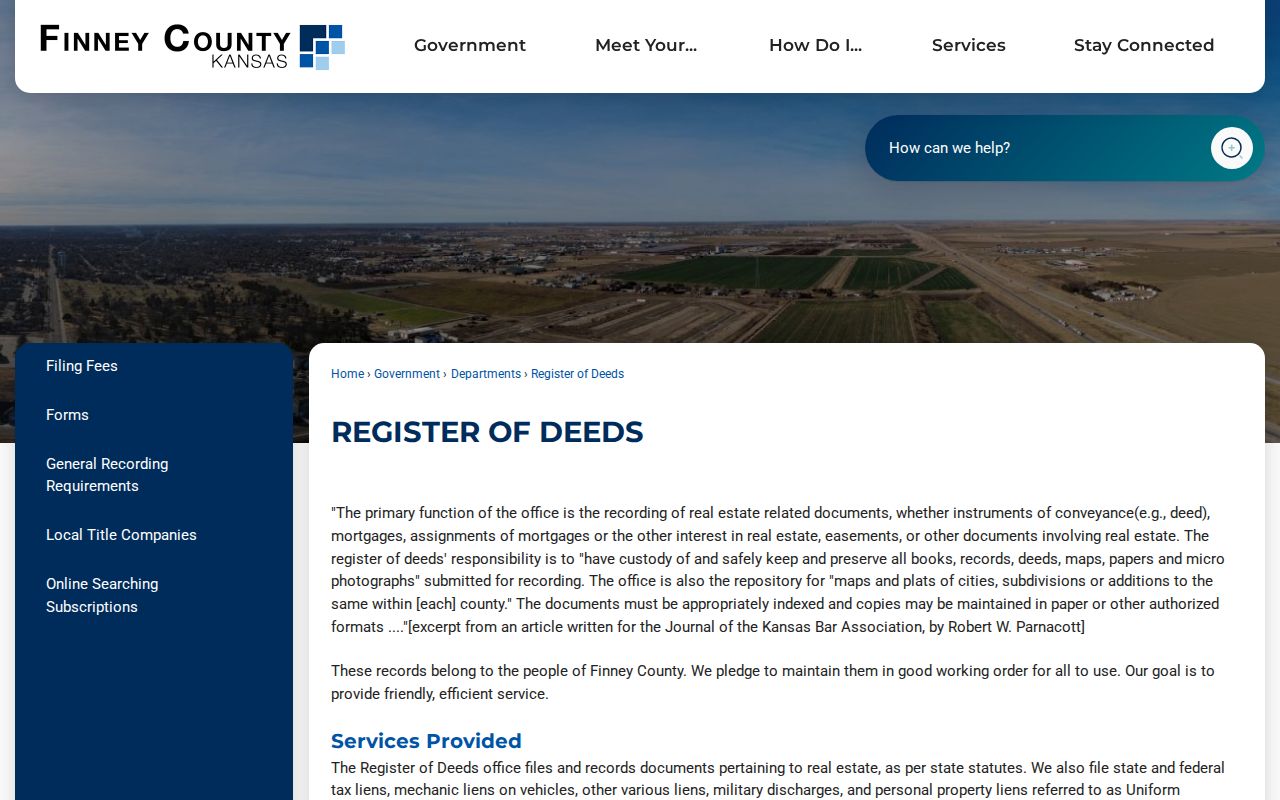
The county page anchors office contact and custody while the online system is changing.
Read Finney County Deed Records as a Chain
Start a chain with the newest deed you trust. Write down its recording date, instrument or book/page reference, grantee, grantor, and legal description. Then search that grantor as a grantee in an earlier deed, match the legal description of the same land, and repeat the process. When gaps appear, look to mortgages, releases, probate instruments, or entity changes for the explanation.
- Find the current parcel and exact legal description.
- Locate the newest deed naming the displayed owner as grantee.
- Take that deed's grantor into the earlier index.
- Verify dates and legal description at every link.
- Move to office-held books or microfilm when online coverage ends.
Deed-index vocabulary
Three terms carry most of the weight. The grantor conveys an interest, the grantee receives it, and the chain of title is the connected sequence those transfers form. A book/page or instrument number points to a document, not to a parcel.
2026 Access to Finney County Deed Records
A July 17, 2026 county announcement reported the move to Fidlar AVID. Laredo launched for professional subscribers, and Tapestry handles browser-based pay-per-search at LandRecords.com. The separate subscription page still points interim researchers to the office for official index pages. Read both together before relying on either one alone.
The live AVID system, not this page, defines which deed records carry images. Legacy RMIS paperwork described documents from 1990 forward along with historic subscription prices. That paperwork describes the former system. It is not a current promise about the Finney County recorder's holdings.
Search Fields for Finney County Deed Records
| Party | Grantor and grantee names, including entity-name variants |
|---|---|
| Document type | Deed, mortgage, release, easement, plat, lien, or covenant |
| Date | Recording date and a practical search range |
| Reference | Instrument number or book and page |
| Land | Legal description, parcel identifier, subdivision, block, and lot |
| Image | Whether an online image or official copy is available |
The county's former portal carried a plain warning. The official records stay at the office, and system accuracy is not guaranteed. A request built on exact names plus a land description will always beat a broad surname search alone.
Easements in Finney County Deed Records
A conveyance names the parties. Use questions, though, can turn on a right-of-way agreement, utility easement, protective covenant, city ordinance, subdivision plat, or recorded survey. Search those instrument families against the same owner names and legal description. State and federal tax liens, mechanic's liens, special-assessment liens, sewer-district liens, and recorded court notices can also shift the chronology of a parcel's record.
Note: A filed instrument proves only that a public record of filing exists, not the priority, validity, or final outcome of any litigation.
Filing Rules for Finney County Deed Records
Originals must be legible before anything else. The first page needs a 2.75-inch top margin, and later pages need .75-inch margins. Unplatted land calls for metes and bounds tied to section, township, and range. Platted land is described by lot, block, and subdivision. Deeds also need original signatures. They require an original notary seal and the proper fee too. A legal description is required, along with a Kansas Sales Validation Questionnaire. Simplifile e-recording handles qualifying deeds until the 4 p.m. cutoff, though personal-property liens are excluded. The office neither prepares nor notarizes deeds.
Getting an Official Finney County Deed Copy
The Register of Deeds sits at 311 N Ninth Street, Garden City, Kansas 67846, reachable at (620) 272-3520, open Monday through Friday, 8 a.m. to 5 p.m. Recorded documents are usually ready for pickup or mailing the next business day. K.S.A. 28-115 governs the fees. Ask for the current county schedule instead of trusting an old portal price.
Bring specifics with you. A party name, parcel or legal description, document type, instrument or book/page number, and date range will do. Staff can retrieve and copy identified deed records. They will not build a title opinion.
Older Finney County Deed Records Beyond the Portal
Finney County was organized in 1884, after its earlier Sequoyah County period. The recorder holds the old books, maps, microphotographs, and plats. The Finney County Historical Museum Research Library adds newspapers, maps, manuscripts, photographs, and microfilm. Visits are by appointment. Kansas Memory preserves 1884 correspondence about the county's organization.
For a historic Garden City parcel, pair the deed and plat chain with newspaper references to Silk Stocking Row. Cedar Cliff references help too. Newspaper evidence supplies context, but the recorded instrument remains the authority.
What Recorded Deed Records Do Not Decide
Recorded is not a title opinion. Recording places an instrument in the public chain; it does not guarantee that a deed was sufficient, that every interest was recorded, or that title is clear.
Some questions outrun the record room. Complex ownership, competing legal descriptions, probate gaps, unreleased encumbrances, and active litigation may call for a Kansas attorney or title professional. Military discharges filed with the recorder stay closed to the public, and Kansas Open Records Act exceptions still shield other protected material.
Mortgages in Finney County Deed Records
A mortgage records a security interest in Finney County deed records. An assignment can move the holder's interest. A release or satisfaction shows the claim was discharged. Search these by borrower or other indexed party, legal description, recording date. The reference to the original document matters too. An assignment without its originating mortgage tells only half the story. A mortgage with no release found should be reported as "release not located." Never assume it is unpaid.
The county also records mechanic's, tax, special-assessment, sewer-district, medical-assistance, UCC, and other liens. Each carries its own legal effect and possible release document. Build a chronology that quotes the exact instrument type and status words the record uses. Court litigation can add a lis pendens, judgment, or satisfaction. Compare these against the recorder trail.
Court channels exist when an instrument points to foreclosure, quiet title, partition, probate, or lien enforcement. Kansas CaseSearch and the 25th Judicial District handle that side. An index entry alone decides nothing.
Plats in Finney County Deed Records
Plats live in the Register of Deeds office. The collection holds city plats, subdivision plats, parcel plats, and boundary surveys. Platted land traces back to a lot, block, and subdivision named in the deed. Rural land works differently. There the deed leans on section, township, range, acreage, and metes-and-bounds calls. A Parcel ID speeds up discovery, yet it never substitutes for a true legal description.
Deed records in Finney County hold more than deeds. Easements, right-of-way agreements, protective covenants, restrictions, and ordinances can quietly limit how land gets used. Run the same owner names and land description against all of those instrument types. Do it in the Finney County property records. An old covenant may carry amendments or releases. An easement can be assigned or supplemented later. Pull the full instrument image instead of trusting its index label alone.
The county GIS viewer and planning maps help you get oriented. Neither is a legal survey. A line drawn on screen cannot resolve ambiguity in recorded calls. For a ground-boundary determination, hire a licensed surveyor.
Probate Links in Finney County Deed Records
Death interrupts a clean purchase-to-purchase chain. Probate, a fiduciary deed, an affidavit, or a court order may all step into the sequence. Search Finney County deed records under the decedent, the estate, the personal representative, and any heirs named in public instruments. Add the later grantee. Match the legal description throughout. When a deed cites a case, public probate material is available through Kansas CaseSearch or the district clerk.
Kansas vital records are not generally open. Certified copies require eligibility, so a deed-chain inquiry is not a license for an unrestricted vital-record search. Newspaper notices and museum collections can add historical context or name variants. They cannot convey title. The recorded estate instrument and the court order form the stronger bridge. They lead back into the property records.
Trusts and LLCs need the exact entity caption. A Kansas business-entity result can confirm that the entity itself is real. Only the land instrument, however, ties that entity to the parcel. The deed is what carries the ownership.
How to Request a Finney County Instrument
Prepare before calling or visiting. List the grantor and grantee, the approximate recording date, the document type, and the instrument number or book and page if known. Add the legal description, the parcel identifier, and whether the copy must be certified or uncertified. Ask whether the image sits on the current online platform, can be emailed or mailed, or must be inspected in the office.
The statutes matter here. K.S.A. 45-218 and 45-219 govern general inspection, response times, and actual-cost copy rules, while recorder charges and recording fees may be set more specifically by K.S.A. 28-115 and the current county fee schedule. Historic RMIS subscription prices are not today's copy charge. Never quote them as if they were.
Office staff can retrieve an identified instrument and explain the access channels. The filing office itself will not run a chain-of-title search, prepare deeds, or offer a title opinion. Narrow requests get the useful answers. "Everything about this property" rarely does.