
Three Finney County Value Measures
Appraisal comes first in Finney County. The county GIS map separates land, building, and total appraisal fields for each parcel. Kansas then applies a classification ratio to produce assessed value, and exemptions or special rules can alter taxable treatment while a sale price records a single transaction.
| Value type | Meaning | Source |
|---|---|---|
| Appraised value | County estimate before the class ratio | Parcel record and notice |
| Assessed value | Appraised value multiplied by Kansas ratio | Assessment and tax record |
| Sale price | Transaction figure, when available | Deed and sales sources |
These numbers rarely match, and that is usually fine. Each answers a different question on a different date, so compare like with like before calling a result inconsistent.
Find a Finney County Property Value
Start in the Parcel Information Viewer to locate the right tract. Owner name, Quick Reference ID, and Parcel ID each work as search modes, and matching the situs and legal-location text confirms the parcel. Then save the ParcelID, compact PID, and QuickRefID.
- Locate and verify the parcel polygon.
- Read land, building and total value with the update date.
- Open the Appraiser public portal for assessment detail.
- Use property tax records for a bill, payment or levy question.
- Appraised value
- The estimate before the class ratio.
- Assessed value
- The statutory share used for taxation.
- Taxable value
- The figure after applicable adjustments.
- Sale price
- A historical transaction amount.
Open the Finney Appraisal Record
The public appraisal entry shows how Finney County opens its database to public users.
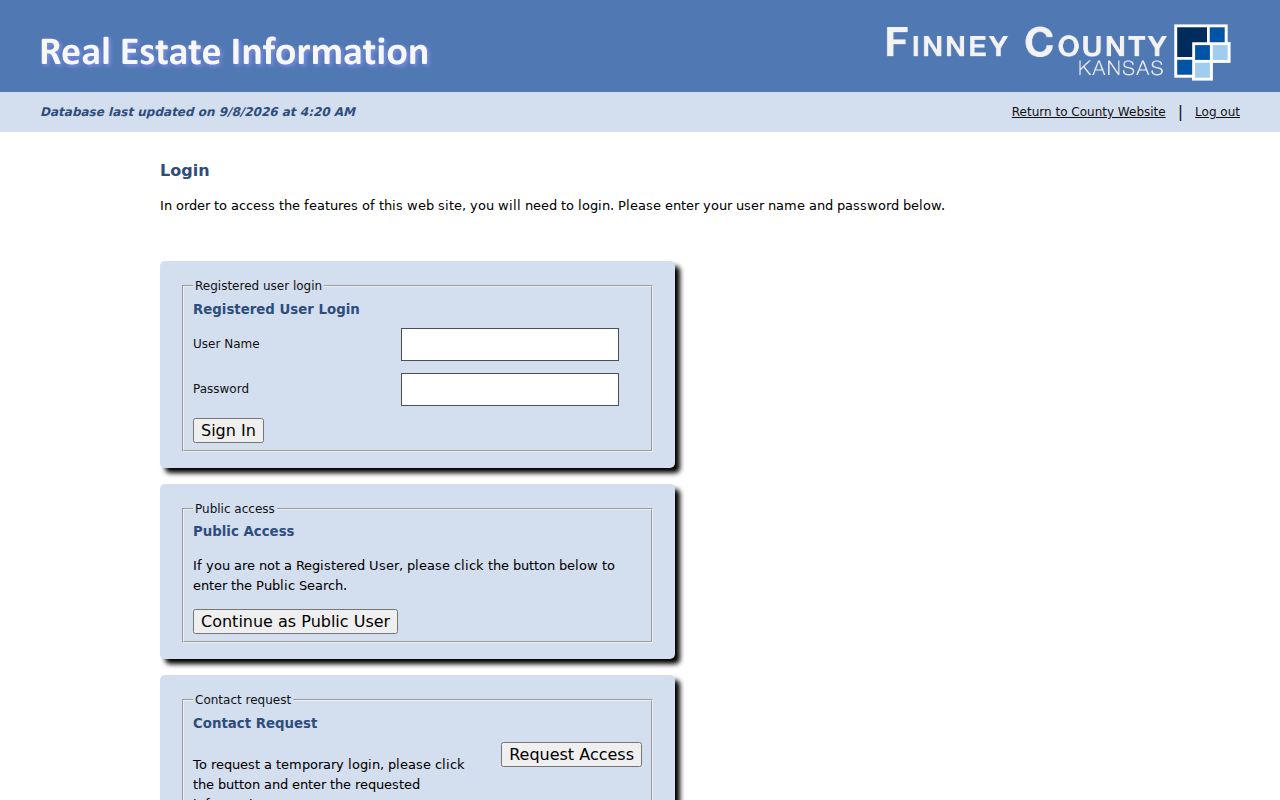
Carry those identifiers into the Finney appraisal record. Every value carries a year, so label each figure instead of copying an unlabeled total.
Finney County's 2026 Market Study
The 2026 market study set countywide patterns. Residential values generally moved 1% to 8%, with central areas closer to 2% to 4%. Vacant land stayed stable. Commercial and industrial property ranged from roughly 5% to 10% in the summary.
These are broad patterns, not parcel promises. Corrected data or comparable sales can push one property outside the range. Notices were to be mailed by March 1. The appeal period ran 30 days from mailing.
Kansas Ratios Change the Recorded Number
Assessed value sits below appraised value by design. Kansas classification treats residential, commercial, vacant, and agricultural property differently. The classification guide names the classes and their percentages. The calculation guide shows how an appraisal becomes an assessment. Agricultural land is different again. Its value follows an economic-use method rather than sale price. Read the agricultural valuation explanation before comparing a farm assessment with residential sales.
County Trends Are Not Parcel Promises
Kansas PVD maps put Finney residential change at 5.13%. Total-value change was 5.05% between November 2024 and July 2025. Those are countywide aggregates. Property class, improvements, condition, acreage, and appraisal date still drive one parcel's worth. Deeper statistics sit at Kansas PVD open data. Keep the dataset date with anything you cite. Never treat a county row as one parcel's appraisal.
Why One Finney Parcel Can Differ
Look at the components, not just the new total. Land and building adjustments can rest on different evidence. Check acreage, class, use, and improvement details against the subject before hunting for comparables. When a characteristic is wrong, name the exact field and bring documentation rather than arguing that the percentage feels high.
A sales area in mass appraisal is not always a subdivision, zoning district, or association. So weigh candidate parcels on physical and legal similarity. A shared place name on some website proves little. Save each candidate's class, component values, and appraisal year.
Mass appraisal groups properties. It cannot reproduce a private inspection. Construction, demolition, corrections, use, quality, depreciation, and comparable sales all separate one parcel from the general trend.
| Unexpected result | Check |
|---|---|
| Land rose, building did not | Separate GIS components |
| Total changed after work | Parcel characteristics and permits |
| Sale price differs sharply | Transfer circumstances and appraisal year |
| Farm figure seems low | Agricultural economic-use class |
Sale Price Is a Historical Fact
A deed's recording date is not the transaction date. Neither equals the assessment date. A late-cycle sale may be missing from a valuation prepared earlier. Keep the transfer type and its official context. Treat nominal or non-arm's-length transfers as something other than ordinary market sales.
Consideration on a deed is historical, not automatic market value. Family transfers, partial interests, and unusual terms make poor comparables. The Finney County deed guide helps locate the instrument. Keep its parties and recording date beside the appraisal year.
A clean comparison needs similar parcels and dates. An asking price is separate again. It reflects a seller's position, not a county conclusion or a closed deal.
Challenge a Finney County Assessment
Read the valuation notice at once. Kansas treats an equalization appeal and a payment under protest as separate routes, so pick one and follow its own instructions. One filing does not preserve every remedy. Keep proof of submission, parcel identifiers, taxpayer details, and copies of every exhibit. The state publishes an appeal guide and a property-tax calendar that explain the current routes.
State the requested outcome plainly. Say whether you want a factual correction, a classification change, or a new total value. Gather the notice, parcel identifiers, wrong property facts, photographs, and comparable evidence. Stay focused on the record and year at issue. Correct factual errors first. Use, acreage, improvements, and classification problems come before value arguments. Then compare genuinely similar properties, not a countywide average. Market-study bands and state change maps add context, but a parcel-level decision turns on the subject record and the evidence Kansas procedure allows.
Build each comparison with care. Save the parcel number, appraisal year, classification, land and improvement components, total, notice date, and update time for the subject property. Document every comparable parcel the same way. A row copied without its year or class can create a false mismatch, especially when agricultural economic-use valuation sits beside market evidence.
A deed and the roll may disagree on timing. Describe the discrepancy instead of calling either source wrong. The deed shows what instrument was recorded. The roll shows what the database displayed on the lookup date. The county states no normal update lag, so ask the Appraiser about pending corrections and keep the response.
Deadline matters. An informal question does not preserve appeal rights. Follow the notice and official procedure within its stated period.
What Finney County Assessor Value Is Not
An assessor value is not a live offer. It is not an asking price. It is not a guaranteed sale price, a survey, or a title opinion. Each of those questions belongs to a different record or a different professional judgment.
End value research with a dated source note. Write down the source. Say whether the figure came from GIS, the appraisal portal, a notice, state statistics, or a deed. Add the property class and component fields. That habit keeps an appraised total from being mislabeled as assessed value and a county trend from sounding like a parcel finding. Save the original screen or notice, not just a handwritten number. Finney systems and appraisal data change. A preserved lookup date shows what the county displayed at that moment.
Purchase diligence needs more than a county figure. Pair the valuation record with a physical inspection, permits, recorded easements, and professional advice. A low or high number alone cannot explain property condition, private transaction terms, title risk, or the exact location of improvements.
Value versus price. A Finney County assessment does not say what a buyer will pay. Obtain a qualified appraisal when a current market opinion is required.