
The Finney County Owner-of-Record Card
PartyName is the GIS popup's owner field. Read it beside the parcel and address fields that tie the name to a specific piece of Finney County land.
| PartyName | Owner name currently displayed by the parcel layer |
|---|---|
| Owner address lines | Mailing destination for notices, separate from the land |
| Property/Situs Address | Physical location of the selected parcel |
| ParcelID / PID | Formatted and compact identifiers used to cross-check the parcel |
| QuickRefID | Separate Appraiser reference useful in an office inquiry |
| LegalLocationDesc | Legal-location clue to compare with the recorded deed |
The owner of record is not necessarily the occupant. A situs identifies the Finney County property, while a mailing address tells you where the county sends correspondence, so record both without merging them.
Check the Finney Appraiser's Public Entry
The Finney County Appraiser portal is the official public-user entry for the assessment record.
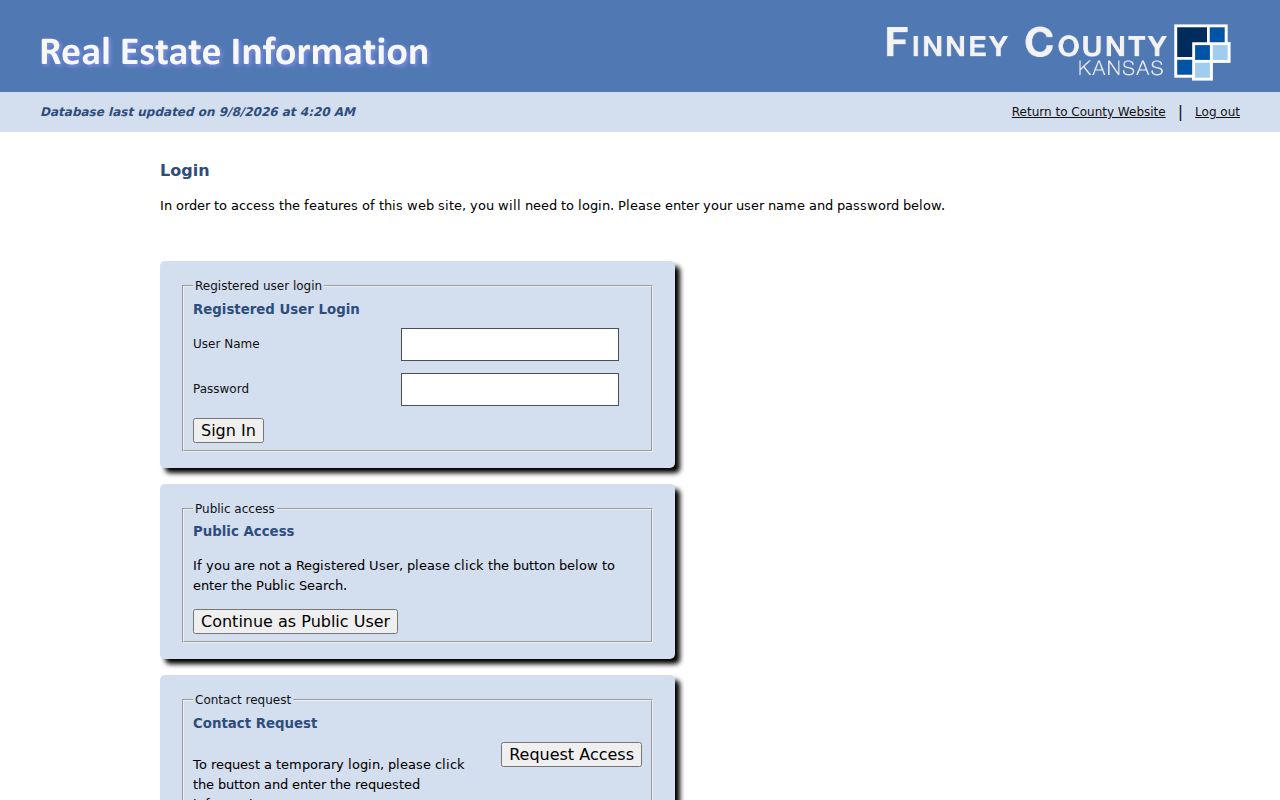
Note the portal's update time and your lookup date.
When a New Deed Still Shows an Old Owner
No standard update lag is published. Finney County posts no usual number of days between deed recording and a refreshed owner display. The Register of Deeds may hold a newer instrument. It may be newer than the GIS PartyName field. In that case, report both facts with their dates. Ask the Appraiser if an update or correction is pending. Do not call the map stale.
Recent-sale caution. The roll can trail a newly recorded transfer; the newest applicable deed is the more current ownership evidence.
Confirm the Current Finney County Owner
Hold the parcel constant from assessment display to recorded proof.
- Capture PartyName, situs, ParcelID, PID, QuickRefID, and legal description from GIS.
- Open the Appraiser record and note its displayed update time.
- Find the latest applicable deed and compare its grantee and legal description.
- For a company, verify the exact name through the Kansas Business Entity Search.
- Owner of record
- The party named by the relevant official record at the lookup time.
- Assessment roll
- The Appraiser's parcel and valuation record, not a title opinion.
- Recording lag
- The interval between recording an instrument and another system reflecting it.
- Registered agent
- A business entity's official process contact, not automatically the landowner personally.
Check Parcel Splits, Mergers, and Annexation
A new parcel identifier can break the match. Names can be right and the current-owner lookup still fails. Preserve every documented ID format, the Quick Reference ID, acreage, and the legal-location fields. Garden City's 2025 K-State Research Station annexation shows why city limits, postal labels, and recorded legal descriptions must be compared in Finney County rather than assumed identical. City limits, postal labels, and recorded legal descriptions can differ. Compare them directly rather than assume they match.
Verify Business, Trust, and Estate Owners
An LLC's state entity record clarifies the exact legal name and registered agent. A trust is different. Read its vesting language and trustee name in the deed, and check Kansas CaseSearch when a probate or court-order transfer appears. These routes confirm a Finney County owner when PartyName is not a natural person.
Use Finney County Owner Data Responsibly
A published owner mailing address is a records field. Kansas Safe at Home protects qualifying participants' address information. K.S.A. 45-230 also limits the use of public lists for solicitation. A Finney County current-owner lookup supports purchase diligence, estate questions, and parcel verification, never intrusive contact.
Lawful use. Never use a Finney County owner record to stalk, harass, threaten, or intimidate another person.
Read a Finney Business or Trust Owner
PartyName may show an LLC, corporation, trust, trustee, or estate rather than an individual. Copy the name exactly, punctuation and all. Compare Kansas businesses with the Business Entity Search Station. The state record can separate similarly named companies and identify a registered agent. The agent is not automatically the property's owner, though. The latest recorded deed must still name the entity as grantee. It must also describe the same Finney County land.
A trust may appear under its formal name, a trustee's name, or both. Never infer beneficiaries from a parcel card. An estate or court-ordered transfer can require a probate, partition, foreclosure, or quiet-title docket search. That search runs through Kansas CaseSearch. The court trail explains authority, while the recorded deed or order is the land-record bridge.
Splits, mergers, replats, and annexations complicate older deed references. An older instrument may not use today's identifier. Hold the legal description, subdivision, lot, block, section, and township/range alongside the current ParcelID. Those geographic keys beat an owner name alone.
Date Every Finney Current-Owner Check
A current-owner result should be reproducible. Record the lookup date and the Appraiser update timestamp. Log PartyName, owner mailing fields, Property/Situs Address, ParcelID, PID, QuickRefID, and the legal-description text. Then log the newest deed's recording date, grantee, deed type, and instrument or book/page reference. If the sources agree, the file shows why. If they differ, it preserves the timing evidence an office inquiry will need.
Never overwrite a discrepancy. State which source showed which name, and on what date. Ask the Finney County Appraiser whether its assessment record awaits an ownership update or correction. Ask the Register of Deeds whether a newer instrument affects the described parcel, and avoid turning an unpublished update interval into an unsupported claim.
An owner mailing address is useful for legitimate property correspondence. It may still be a post-office box, business office, trustee address, or an address outside Finney County. It is not the situs. It does not establish occupancy. Kansas Safe at Home may protect a qualifying person's address, so keep owner research proportionate to the property question and respect every withheld field.
Which record should control after a very recent closing? The newest recorded deed is the stronger proof of transfer. The Appraiser record still governs current assessment administration, while a title professional should handle competing instruments, exceptions, or questions about the legal interest conveyed.
Note: “Current” always means current as of a stated source date; preserve that date whenever the answer matters.
Apply the same care when the mailing city differs from the parcel's location. Finney GIS lists the owner's mailing address separately from the Property/Situs Address. A Garden City parcel may route notices out of state, while a rural tract near Holcomb can carry a mailing label that says nothing about taxing or zoning jurisdiction. Check the taxing-unit and legal-location fields before describing where land actually lies.
Online tools confirm ownership, but the office still matters. The Register of Deeds at 311 N Ninth Street in Garden City keeps Monday-through-Friday hours from 8 a.m. to 5 p.m. and answers at (620) 272-3520. During the 2026 AVID transition, county instructions preserved an office route for official index pages. Bring a parcel ID, exact party name, date range, instrument number, or book/page citation when you can. Staff will locate and copy records. They will not build a title opinion.
Read the newest deed as a whole document. The grantee line names the recipient. The legal description defines the land. Deed type, reservations, exceptions, and signer capacity may all matter. A matching surname attached to a different legal description does not make someone the owner of your parcel. Likewise, a mortgage or lien naming a party links that party to the land without conveying title.
Court events can reshape ownership too. Search the 25th Judicial District through Kansas CaseSearch. Probate, foreclosure, partition, and quiet-title matters explain why a grantee or signing capacity deviates from a routine sale. Confirm the resulting deed or recorded order through the recorder. A docket summary alone is not the current title record.
Keep ownership separate from valuation and tax status. A parcel popup may display land, building, and total values, yet those figures prove nothing about who holds title. Treasurer history identifies a taxpayer or statement account, not the owner of record. Tie each conclusion to its proper source: the Appraiser for current assessment display, the Treasurer for the tax roll and tax bill, and the Register of Deeds for recorded conveyances.
Newly sold parcels sometimes show three different update dates. Note the timing plainly. Rechecking the records later keeps the current-owner conclusion sound.